
How to Improve Payment Collection Using WhatsApp Business API Platforms
Your invoice is 30 days overdue and the customer still has not opened the email. WhatsApp messages get read in minutes, not days, and that gap decides how fast cash lands.
This article walks through six steps for building payment collection on the WhatsApp Business API: getting verified, timing reminder sequences, sending invoices and payment links inside the chat, automating follow-ups, and tracking everything in one inbox. You will also see what to compare across platforms and how Com.bot fits into that decision.
Why WhatsApp Business API Outperforms Email and SMS for Payment Collection
Email and SMS have long been the default channels for payment reminders, but their declining effectiveness is forcing finance teams to look elsewhere. Email open rates typically hover between 20 and 30 percent, and while SMS open rates reach 90 to 98 percent, recipients often glance and dismiss those texts without acting.
WhatsApp changes the math. Industry benchmarks place its open rate near 98 percent, with response rates between 45 and 60 percent. That combination of visibility and engagement is rare in any business communication channel.
Speed matters just as much. Research suggests WhatsApp messages are usually read within five minutes, while an email invoice reminder may sit unopened for hours or even days. For overdue balances, that gap directly affects how quickly cash arrives.
Trust is the third differentiator. WhatsApp's end-to-end encryption and personal, conversational feel make customers more comfortable opening payment links and confirming transactions. A message that feels like it came from a person, not a billing system, reduces the fraud suspicion that plagues email reminders.
Together, these factors explain why finance teams are moving payment collection onto WhatsApp Business API platforms. The sections that follow break down the specific mechanics, from open rates to trust signals, before moving into the step-by-step setup.
Open Rates, Response Speed, and Trust Signals That Drive Faster Payments
When a payment is overdue, the channel that gets opened first wins. The numbers behind WhatsApp's advantage explain why it consistently beats email and SMS on that front.
| Channel | Typical Open Rate | Typical Response Rate | Typical Read Time |
|---|---|---|---|
| 20 to 30 percent | Low | Hours to days | |
| SMS | 90 to 98 percent | Often ignored | Minutes, low action |
| Around 98 percent | 45 to 60 percent | Within 5 minutes |
The response rate gap is the real story. An SMS may be seen, but seeing is not the same as acting. WhatsApp's conversational format invites a reply, whether that is a question about the invoice or a tap on a payment link.
Real-time delivery compounds the effect. A reminder that lands while the customer is already holding their phone converts far better than one buried in an inbox. This is why automated reminders sent through WhatsApp tend to shorten the collection cycle.
Trust signals do the rest of the work. End-to-end encryption means payment details and documents stay private between sender and recipient. Customers recognize the app, understand how it works, and feel safer tapping a payment link inside a familiar thread than in an unsolicited email.
Consider a typical example. A business sending invoice reminders by email might see average payment times stretch to about a week. After switching those same reminders to WhatsApp with a document-based invoice and a call-to-action button, that window can shrink to roughly two days. The reminder itself did not change. The channel did.
That is the core lesson for accounts receivable teams. Better open rates, faster reads, and stronger trust all push the same direction: money arrives sooner, and follow-up effort drops.
Step 1: Get Verified and Set Up Your WhatsApp Business API Correctly
Before you can send a single payment reminder, you need to navigate the verification and setup process for the WhatsApp Business API. This step is not optional paperwork. It is the foundation that determines whether your invoice delivery, payment links, and automated reminders actually reach customers.
Meta treats the API differently from the consumer app. Your account must be tied to a legitimate business entity, and the quality of your setup directly affects message deliverability. A rushed configuration leads to lower open rates and possible account restrictions.
Work through the five tasks below in order. Each one builds on the last, and skipping ahead usually means starting over.
- Choose a Business Solution Provider (BSP). The WhatsApp Business API is not something you sign up for directly with Meta. You access it through a BSP, which handles hosting, onboarding, and technical integration. Platforms like Com.bot operate in this space. Compare providers on onboarding support, template management, and how they connect to your existing payment gateway integration.
- Submit your business for Meta verification. This requires legal documents such as a business registration certificate, tax identification, and proof of your official business name and address. The name on these documents must match the display name you intend to use. Mismatches are one of the most common reasons verification stalls.
- Set up a dedicated phone number. Use a number that is not already active on the personal WhatsApp app. A fresh number or one that has been fully removed from the consumer app works best. This number becomes the sender identity for every transaction notification and reminder you send.
- Configure your business profile. Add your logo, a clear business description, your website, and contact details. This is what customers see when they open your message thread, so it functions as a trust signal before they ever read a word.
- Apply for green tick verification if eligible. The green tick confirms to customers that they are talking to a legitimate business. It is not guaranteed, and eligibility depends on factors like business notability and compliance history, but applying is worthwhile for any organization handling digital payments.
Proper setup pays off in two ways. First, verified senders tend to see higher trust and better deliverability, which matters when a message contains a payment link or a PDF invoice. Second, a clean configuration reduces the risk of flags during high-volume sending, such as a batch of recurring billing reminders at month end.
Watch for these common pitfalls:
- Using an unverified number, which hurts open rates and can trigger a ban
- Submitting documents that do not match your display name
- Reusing a personal WhatsApp number instead of a dedicated one
- Leaving the business profile incomplete, which weakens customer engagement
- Ignoring opt-in compliance from day one, since WhatsApp Business Policy requires consent before you message anyone
Treat this checklist as a gate. Once verification is complete, your number is confirmed, and your profile is filled out, you are ready to build the message templates and automated reminders that drive payment collection.
Step 2: Build a Payment Reminder Sequence That Converts
A well-timed reminder sequence can mean the difference between payment in 24 hours and a 30-day chase. Rather than sending a single message after an invoice goes unpaid, a structured sequence uses multiple touchpoints across the billing cycle.
Each message in the sequence should escalate in urgency while staying polite. The goal is to keep the customer informed, not to pressure them. A clear progression also protects the relationship you have worked to build through conversational commerce on WhatsApp.
Timing, Frequency, and Tone: What Works at Each Stage of Overdue
The optimal reminder cadence balances persistence with respect for the customer's time. Too few messages let invoices slip through the cracks, while too many can push customers to block your business number entirely. A staged approach solves this by matching the message to how overdue the payment actually is.
Each stage below includes a suggested tone and a short example template. Personalize every message with the customer's name, invoice number, amount, and due date. Generic reminders feel automated and get ignored, while specific ones prompt action.
| Stage | Timing | Tone | Example Template |
|---|---|---|---|
| 1 | 3 days before due | Friendly, no urgency | "Hi [Name], just a heads-up that invoice #[Number] for [Amount] is due on [Date]. Let us know if you need anything." |
| 2 | On the due date | Gentle nudge | "Hi [Name], invoice #[Number] is due today. You can pay in a few taps here: [Payment Link]." |
| 3 | 1 day overdue | Polite but clear | "Hi [Name], we have not received payment for invoice #[Number] yet. A late fee may apply after [Grace Period]. Pay here: [Payment Link]." |
| 4 | 3 days overdue | Firmer, solution-oriented | "Hi [Name], invoice #[Number] is now 3 days past due. If a payment plan would help, reply and we can set one up." |
| 5 | 7 days overdue | Final notice before escalation | "Hi [Name], this is a final reminder for invoice #[Number]. Please settle by [Date] to avoid further action." |
On frequency, a sensible approach is to keep the sequence measured and steady rather than sending messages too often. This keeps the sequence from crossing into harassment while still maintaining steady pressure. The tone should shift gradually from helpful to firm, but it should never become threatening.
Personalization is the thread that ties every stage together. Include the customer's name and invoice details in each template message so the recipient knows the reminder is meant for them, not a bulk send. This small detail improves both response rates and the overall customer experience.
Step 3: Send Invoices and Payment Links Directly in the Chat
Sending an invoice as a PDF attachment in WhatsApp is convenient, but embedding a payment link takes it a step further. Both methods work inside a single conversation, so the customer never has to search through email folders or log into a portal to find what they owe.
The first method uses a document message. You attach the invoice as a PDF, and it arrives in the chat just like any other file. Customers recognize this format, finance teams can archive it, and the layout matches what they already expect from traditional invoice delivery.
The second method relies on payment links. Instead of a static file, the customer receives a clickable URL or an interactive message with a call-to-action button such as "Pay Now." A tap opens the checkout, and the payment can be completed in moments.
Each approach has trade-offs worth understanding:
- PDF invoices: familiar, easy to forward to an accounts payable team, and simple to store for records. The downside is that payment still requires a separate step, which adds friction.
- Payment links: fewer steps between the invoice and the money, which reduces drop-off and speeds up payment collection. They also make it easier to track whether a customer has paid.
WhatsApp also supports interactive messages with call-to-action buttons, quick reply buttons, and list messages. These formats turn a plain notification into a lightweight payment prompt. For businesses handling accounts receivable, that small design choice can shorten the gap between sending an invoice and getting paid.
Combining both methods often works best. Send the PDF for records, and attach a payment link or "Pay Now" button so the customer can act immediately.
Using Native Payments for WhatsApp Transactions
Native payments allow customers to complete a transaction without leaving the WhatsApp interface. Rather than tapping a link that opens a browser, the customer stays in the chat from start to finish.
This works through payment gateway integration. A business connects its gateway to the WhatsApp Business API platform, and the platform handles the handoff between the chat and the payment processor. Com.bot offers native payments for WhatsApp transactions as part of its platform, alongside its WhatsApp Business API integration and payment collection features.
The customer experience follows a short path:
- The customer receives the invoice in the chat.
- They tap the "Pay Now" button.
- They select a payment method, such as a credit card, UPI, or another supported option.
- They receive a payment confirmation in the same conversation.
The main advantage is fewer drop-offs. Every redirect to a browser or a separate app is a chance for the customer to abandon the payment. Keeping the transaction in chat removes those exits and supports faster checkout.
Native payments also feed directly into payment confirmation and transaction notifications. Once the payment clears, the platform can trigger a receipt or update automatically, which helps with payment reconciliation and keeps the customer informed without extra manual work.
Two practical conditions apply. First, this feature requires a supported payment gateway, so businesses should confirm compatibility before rolling it out. Second, availability can vary by region, since payment methods and regulatory rules differ from country to country.
For teams managing recurring billing or dunning management, native payments pair well with automated reminders. A customer who misses a due date can receive a template message with a payment button, and the whole cycle stays inside one thread. That combination supports steadier cash flow optimization and a smoother customer engagement experience overall.
Step 4: Automate Follow-Ups Without Sounding Like a Robot
Automation is essential for scaling payment follow-ups, but it must feel human to be effective. A customer who receives a stiff, generic overdue notice may feel annoyed or embarrassed, and that emotional reaction rarely speeds up payment. The goal is to combine the efficiency of automated reminders with the warmth of a personal message.
The good news is that WhatsApp Business API platforms give you the tools to do both. With the right setup, you can send timely, relevant reminders at scale while still making each customer feel like a person, not a ticket number.
This step covers how to build follow-up sequences that sound natural, when to hand things over to a human, and how a visual bot builder can make the whole process easier to manage.
Use the customer's name and reference specific invoice details. A message that says "Dear Customer, your payment is overdue" feels cold and impersonal. Compare that to: "Hi Sarah, just a friendly reminder that invoice #1234 for $500 is due today. You can pay here: [link]." The second version respects the customer, gives them the exact amount, and makes paying easy.
Including a payment link in the reminder reduces friction. The customer does not have to search for a portal or log in to a separate system. They tap, they pay, and the transaction is done. This is where payment gateway integration matters, because it connects the reminder directly to the payment action.
Vary your message templates. Sending the same wording every time quickly starts to feel robotic. Rotate between a few polite variations, and adjust the tone based on how far past due the invoice is. A gentle nudge three days before the due date reads differently from a firm follow-up two weeks later.
Use message templates approved under the WhatsApp Business Policy for these reminders, and reserve free-form session messages for when the customer replies and a real conversation begins. This keeps you compliant while still allowing natural back-and-forth.
Always include a human handoff option. Automation should never trap a customer in a loop. If someone responds with a question, a dispute, or a request for a payment plan, the conversation should route to a live agent. This is where a Unified Team Inbox helps, because it gives your team one place to see and respond to those escalations.
A simple rule works well: automate the routine, escalate the unusual. Most customers just need a clear reminder and a working link. The moment they need something more, a person should step in.
Com.bot's Visual Bot Builder uses a drag-and-drop interface, so you can design these follow-up sequences without writing code.
This kind of conditional automation keeps the experience relevant. The customer is not pushed through a fixed script. Instead, the sequence adapts to what they actually need, which is what makes automated reminders feel helpful rather than mechanical.
Here are practical techniques to keep your follow-ups human:
- Personalize every message with the customer's name and the specific invoice number and amount.
- Reference the due date clearly so there is no ambiguity about what is owed and when.
- Include a payment link that takes the customer straight to checkout.
- Vary your templates so the same phrasing does not repeat across every reminder.
- Offer a human handoff whenever the customer replies with a question or concern.
- Use interactive messages such as quick reply buttons to let customers confirm payment or request help with one tap.
Combining these techniques with automated reminders gives you the best of both worlds: the reach and consistency of automation, plus the personal touch that keeps customers engaged. Done well, this approach supports cash flow optimization without damaging the customer relationship.
Step 5: Let Customers Pay in the Channel They Already Use
Forcing customers to log into a portal or navigate a complex checkout page is a major cause of payment delays. Every extra step gives a busy customer a reason to postpone, and postponed payments turn into overdue invoices.
Most customers already open WhatsApp dozens of times a day. Meeting them there removes the need to remember a password, find an old email, or download a PDF invoice. The payment request arrives in a conversation they already trust.
Traditional collection methods create friction at every stage. An email with a PDF invoice requires the customer to open an attachment, locate a payment link, and often create an account before paying. A portal login adds another barrier: forgotten credentials, password resets, and unfamiliar interfaces.
In-chat payment works differently. A WhatsApp Business API platform can deliver the invoice, the payment link, and the confirmation inside one thread. The customer never leaves the conversation, and your finance team sees the payment status update in real time.
This approach also supports better customer engagement. Reminders, transaction notifications, and payment confirmations all live in the same channel, so context is never lost. The next section explains why fewer steps translate directly into faster cash flow.
Reducing Friction: One-Tap Checkout vs. Redirects and Portals
Every additional step in the payment process increases the likelihood of abandonment. The pattern is consistent: the shorter the path, the more invoices get paid.
Consider how the three common options compare.
- Portal login: The customer must remember credentials, reset a password if forgotten, then locate the correct invoice. Each step is a chance to walk away.
- Redirect to a payment page: The customer leaves WhatsApp, waits for a page to load, re-enters details, and hopes the session does not time out. Drop-off climbs with every second of delay.
- One-tap checkout: The customer taps a call-to-action button in the chat and confirms payment using a saved method or tokenized card. No new account, no re-typed card number.
Tokenization is what makes one-tap checkout fast. A payment gateway integration stores a secure token instead of raw card details, so repeat payments need only a confirmation. For recurring billing, this turns each cycle into a single tap rather than a fresh checkout.
A practical example shows the difference. A customer receives an automated reminder with an interactive message and a "Pay Now" quick reply button. They tap it, confirm with a saved card, and see a payment confirmation shortly after. Compare that to a portal login that can take several minutes, if the customer completes it at all.
The cash flow effect is direct. Faster payments shorten the accounts receivable cycle, reduce the need for dunning management follow-ups, and make payment reconciliation simpler because every transaction is tied to a chat thread. Reducing friction is not a convenience feature. It is a cash flow strategy.
Step 6: Track, Segment, and Escalate with a Unified Team Inbox
As your payment collection scales, managing conversations across multiple agents becomes a logistical challenge. One customer replies on WhatsApp, another sends a question through Instagram, and a third uses the web widget on your site. Without a central place to track these threads, invoices slip through the cracks and follow-ups get missed.
A unified team inbox solves this by consolidating WhatsApp, Facebook Messenger, Instagram DM, and web widget conversations into a single interface. Instead of switching between apps, agents work from one screen. That matters for accounts receivable because every payment conversation stays visible and accountable.
Com.bot offers a unified team inbox as part of its platform, alongside WhatsApp Business API integration and multi-channel support for WhatsApp, Facebook and Instagram. The goal is simple: no customer message about an invoice goes unanswered because it landed in the wrong inbox.
Here is why consolidation changes the way a collections team operates:
- Full conversation history: Any agent can open a chat and see every prior message, payment link sent, and customer reply. No one asks the customer to repeat themselves.
- Chat assignment: Conversations can be routed to a specific agent, so ownership is clear and nothing sits idle.
- Collaboration: Team members can coordinate on a single case rather than working in isolated silos.
- Role-based access: Team collaboration with role-based access keeps sensitive payment discussions with the right people.
Once conversations live in one place, the next step is organizing them. Segmentation turns a busy inbox into a prioritized worklist.
Tag customers by payment status so agents know instantly where each case stands. Common tags include paid, overdue, and promise to pay. A customer tagged "promise to pay" with a date attached should not receive the same reminder cadence as someone tagged "overdue" for thirty days.
Tags also drive automation. If a customer tagged "overdue" does not respond within a set number of days, the case can escalate to a supervisor automatically. This removes the manual step of scanning for stale conversations and keeps dunning management consistent across the team.
Escalation rules should be defined before they are needed. Decide the response window, the tag that triggers escalation, and who receives the handoff. Then let the system enforce it.
Consider a typical workflow. A payment reminder goes out using an approved message template with a payment link attached. The customer replies with a question about the amount. An agent picks up the chat, answers, and shares a PDF invoice for clarity. The customer pays through digital payments, and the case is marked resolved.
That entire sequence happens inside one thread. The agent sees the original reminder, the customer's question, the invoice sent, and the final payment confirmation. Nothing is reconstructed from memory or scattered screenshots.
This matters for reconciliation too. When a case is marked resolved, the tag updates and the conversation drops out of the active worklist. Supervisors get a clean view of what is still open, what is promised, and what has been paid.
Pair the inbox with automation and the loop tightens further. Automated reminders handle the first touch. The inbox handles the human reply. Escalation handles the exception. Each layer reduces the chance that a genuine payment issue is ignored.
For teams running high volumes of recurring billing, this structure protects cash flow optimization without adding headcount. Agents spend time on conversations that need judgment, while the system tracks and routes the rest.
Choosing a WhatsApp Business API Platform: What to Compare
Not all WhatsApp Business API platforms are created equal, especially when it comes to payment collection. Some focus on messaging alone, while others bundle in payment gateway integration, automation, and multi-channel support that make collecting money faster and simpler.
Before committing to a platform, compare the criteria that directly affect how well you can send invoice delivery messages, automated reminders, and payment links. A weak fit in any one area can slow down your accounts receivable cycle.
- Ease of setup: How quickly can your team connect a number, verify your business, and start sending template messages?
- Bot builder capabilities: Does the platform offer a visual builder for smart chatbots, or does it require developer work for every flow?
- Payment gateway integration: Can you process digital payments natively or connect external gateways for payment links and recurring billing?
- Multi-channel support: Does it handle WhatsApp, Facebook, and Instagram from one place, or only WhatsApp?
- Pricing: Look at plan tiers, per-seat costs, and add-ons so you can forecast total spend as your volume grows.
- Customer support: Check what support channels exist and whether they match your time zone and response expectations.
- Compliance: Confirm the platform follows WhatsApp Business Policy, supports opt-in compliance, and handles session messages versus template messages correctly.
These criteria matter because payment collection depends on reliability. A platform that struggles with document sharing, PDF invoices, or payment confirmation messages will create friction for your customers and your finance team.
With those comparison points in mind, it helps to look at a concrete example. The next section reviews how one platform, Com.bot, approaches payment collection across features, pricing, and global reach.
How Com.bot Supports Payment Collection: Features, Pricing, and Global Reach
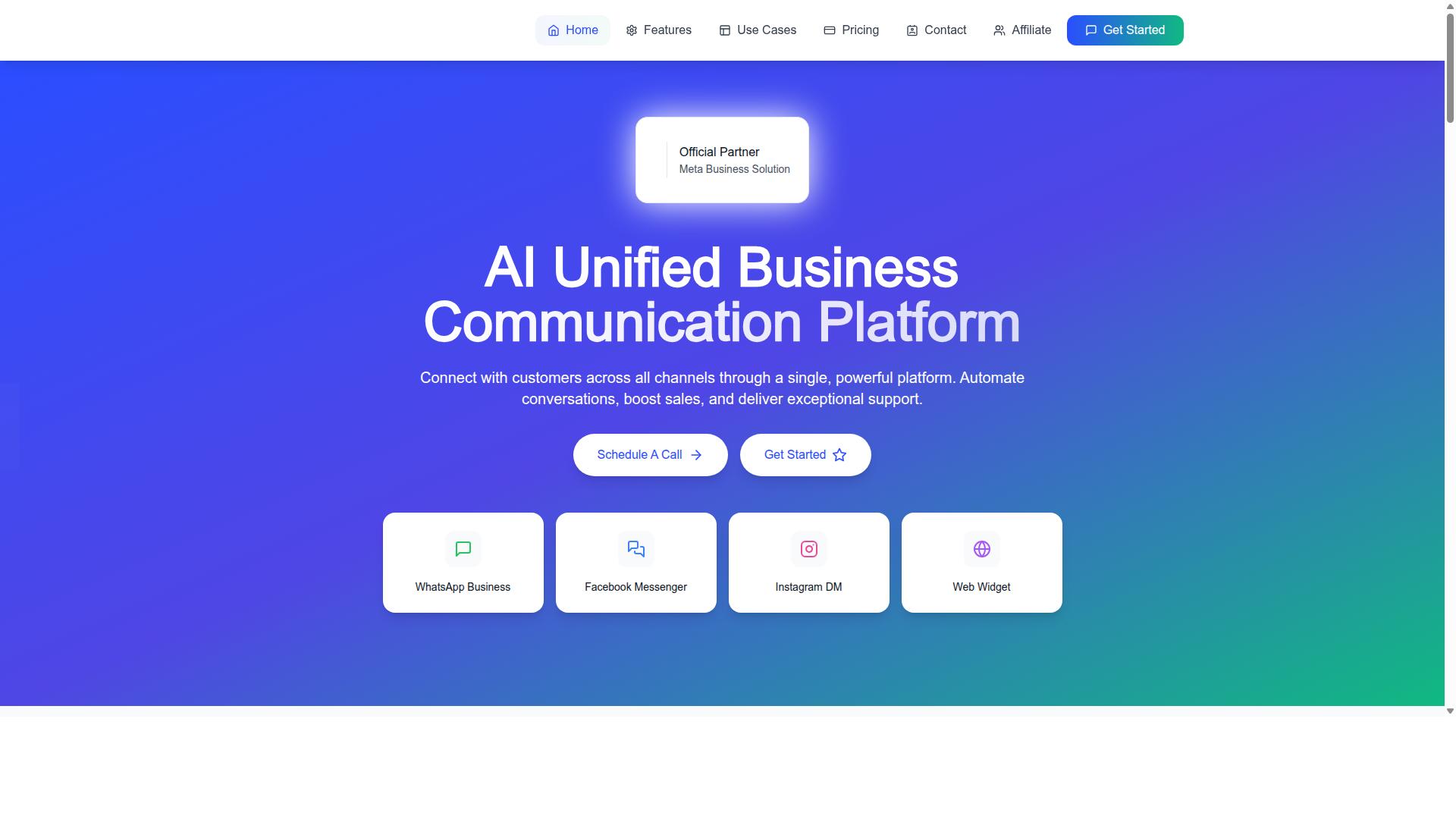
Com.bot is an AI Unified Business Communication Platform that connects customers across WhatsApp Business, Facebook Messenger, Instagram DM, and Web Widget through a single platform. For teams focused on payment collection, that means conversations about invoices, reminders, and confirmations stay in one place instead of scattering across tools.
The platform includes WhatsApp Business API integration and a Unified Team Inbox, so support and finance staff can manage customer replies together with role-based access. A Visual Bot Builder with a drag-and-drop interface lets teams design smart chatbots for order updates, notifications, and payment collection flows without writing code from scratch.
Native Payments for WhatsApp transactions stands out for payment collection. Combined with the Automation Builder and its 1000+ integrations, teams can connect external systems for invoice delivery, payment links, and transaction notifications. Bulk Messaging supports sending reminders at scale, while document sharing and PDF invoices fit naturally into the same thread.
Com.bot also offers Multi-Channel Support for WhatsApp, Facebook and Instagram, plus Customer Support, Team Collaboration, and related products like Tasks.Bot, Tickets.Bot, and Calendars.Bot for teams that need task automation, event ticketing, or AI appointment booking alongside messaging.
| Plan | Price |
|---|---|
| Silver Plan | $149 per quarter |
| Gold Plan (recommended) | $349 per quarter |
| Platinum V1 | $2500 per quarter |
| Additional team member add-on | $10 per month each |
On reach and trust, Com.bot is an Official Meta Business Partner available worldwide and serving 50+ countries. It reports 23,000+ active customers, 100+ government bodies, 500+ global partners, 25M+ messages per day, 100K+ bots created, and enterprise security.
For payment collection specifically, the combination of native payments, automated reminders through the Automation Builder, and multi-channel coverage gives finance teams a practical way to reduce manual follow-up. The tiered pricing also lets smaller teams start on Silver while larger operations scale into Gold or Platinum as message volume and seat count grow.
Compliance and Security Essentials for Payment Messaging
Sending payment reminders via WhatsApp requires strict adherence to Meta's policies and data protection regulations. A single misstep, such as messaging a customer who never agreed to be contacted, can trigger complaints, template rejections, or account restrictions. For any business running payment collection at scale, compliance is not a legal formality. It is the foundation that keeps the channel open and trusted.
Security matters just as much. Payment messages often reference balances, invoice numbers, and account details. Customers need confidence that this information stays private. As an Official Meta Business Partner, Com.bot provides enterprise security with end-to-end encryption, which helps protect payment-related conversations in transit.
The sections below cover the three pillars of safe payment messaging: opt-in rules, platform policy, and data privacy law. Each one carries practical steps you can apply to your WhatsApp Business API setup right away.
Opt-In Requirements and Consent Records
Before any payment reminder, invoice delivery, or transaction notification goes out, the customer must have agreed to receive messages on WhatsApp. Consent should be explicit, not assumed from an existing email relationship or a phone number collected at checkout.
Good practice means capturing consent at a clear moment, such as during account signup or when a customer selects WhatsApp as a preferred contact channel. The record should note what the customer agreed to, when, and through which channel. If a dispute arises, that record is your defense.
- Ask for opt-in separately from general terms acceptance
- State clearly that messages will include payment reminders and invoice delivery
- Store the date, time, and source of every consent
- Honor opt-outs immediately and permanently
An opt-out link or keyword should appear in every payment message. When a customer replies STOP or taps an opt-out option, the system must suppress future sends without delay. Keeping consent records and opt-out logs in one place makes audits far simpler.
WhatsApp Business Policy and Template Rules
Meta's WhatsApp Business Policy prohibits spam, unauthorized messaging, and any use of the platform that feels intrusive. Payment-related messages are usually sent as template messages, which must be pre-approved and fit defined categories such as utility or authentication. Session messages, by contrast, only apply within an open customer service window.
Message templates for payment collection should be factual and specific. A reminder that names the invoice, the amount due, and a payment link performs better than a vague nudge, and it is also more likely to pass review. Avoid promotional language inside a utility template, since mixed intent is a common reason for rejection.
Regular template audits keep quality high. Review approval status, delivery rates, and customer replies on a set schedule. If a template starts drawing blocks or reports, revise or retire it before it affects your sender quality rating.
Interactive elements can improve both compliance and response. Quick reply buttons let customers confirm a payment or request more time, while call-to-action buttons can open a payment link directly. These formats keep the exchange purposeful and reduce the chance of messages being marked as unwanted.
Data Privacy Laws: GDPR, CCPA, and Beyond
Payment messaging touches personal and financial data, so privacy law applies directly. Under GDPR, customers in the EU have rights to access, correct, and erase their data, and businesses must have a lawful basis for processing. Under CCPA, California consumers can request disclosure of collected data and ask that it not be sold.
In practice, this means limiting what you send over WhatsApp. Share only what the payment conversation requires, such as an invoice reference or a secure payment link. Never place full card numbers, bank credentials, or sensitive identifiers inside a chat message.
- Keep a lawful basis documented for every contact
- Respond to data access and deletion requests within legal timeframes
- Retain payment messages only as long as needed for records or disputes
- Train staff on what may and may not be shared in chat
Com.bot makes its cancellation policy, privacy policy, and terms of service available so businesses can review how data is handled before committing. Reading those documents is a sensible first step for any finance or compliance team evaluating a WhatsApp Business API platform.
Security Controls: Encryption, Storage, and PCI DSS
WhatsApp protects messages with end-to-end encryption, meaning content is secured between sender and recipient. That covers the transport layer, but it does not cover what your business stores afterward. Secure storage of payment details, access controls, and audit trails remain your responsibility.
If your workflow involves handling card data at any point, PCI DSS compliance applies. The safest approach is to avoid touching card data altogether. Send a payment link that routes the customer to a compliant payment gateway, so the transaction happens outside the chat and your systems never store card numbers.
Payment gateway integration supports this model well. The customer taps a link, completes the digital payment on a secure page, and receives a payment confirmation back in the conversation. Recurring billing and dunning management can follow the same pattern, with automated reminders sent only to customers who opted in.
A short security checklist helps teams stay consistent:
- Confirm encryption is active across all message flows
- Restrict who can view payment conversations and customer records
- Route card payments through a PCI DSS compliant gateway
- Log access to payment data and review logs periodically
- Test opt-out handling and consent records on a regular schedule
Strong compliance and security practices do more than avoid penalties. They protect customer trust, which is what keeps payment collection over WhatsApp effective in the long run. A platform built with these safeguards in place, such as one backed by Official Meta Business Partner status, gives finance teams a safer starting point for accounts receivable and cash flow optimization.
Recommended Resources: